Sleep tips
How Switzerland Sleeps
By Deluxe Sleep · Published on
Contents
How Switzerland Sleeps
Without healthy sleep, not only our mental well-being suffers, but also our physical health. BICO has been committed to high-quality sleep and innovative sleep solutions for 160 years now. To better understand its customers' needs and offer the best possible products, BICO conducted a sleep study together with the market research company LINK. We carry BICO in our range, and here we present the key results of this study. It found that ergonomics, stress and climate, among other factors, have a direct influence on sleep quality.
Trouble falling asleep or afternoon naps: these are the sleep habits of people in Switzerland
It takes the time it takes: 7 to 9 hours of sleep per night is the average that doctors recommend for optimal rest at night. The majority of people in Switzerland stick to this and sleep an average of about 7 hours during the week, with most going to bed between 10 and 11 p.m. on weekdays. On weekends, respondents allow themselves a little more time and go to bed between 11 p.m. and midnight – 20% then sleep a full 9 hours. But not everyone falls asleep right away: only 28% of respondents said they fall asleep within the first 5 to 10 minutes. That means one in five people has trouble falling asleep. This affects the length of the night's rest, which is why 1 in 10 people in Switzerland recharges energy during the day with an afternoon nap. Interesting to know: people in French-speaking Switzerland take an afternoon nap more often than the rest of the country.
Ergonomics – finding the right mattress firmness
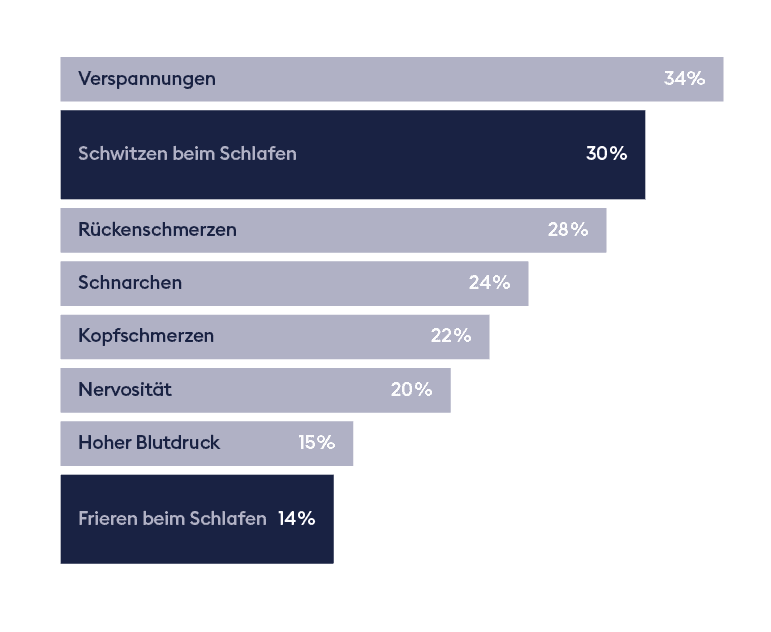
As you make your bed, so you lie in it. Or in this case: so you sleep. The direct link between a high-quality sleep surface and good sleep has in fact been scientifically proven. While 34% of all people in Switzerland feel tense when getting up, 11% even wake up because of back or neck pain. A wide range of factors can promote tension and strain. This makes an ergonomic sleeping position at night all the more important, so the body can recover from the day's strains. Our tip: make sure your spine is kept straight to prevent back, neck and shoulder pain. The right pillow also plays an important role here. You can find out more in our blog post "Prevent back pain – with the right mattress".
The right temperature in the bedroom
Temperature also plays an important role in sleep. BICO's study found that 30% of people in Switzerland sweat at night and 14% feel cold. This has an enormous impact on sleep. Why? Because the body is busy regulating its temperature and thus "fights against" sleep. If it's too cold, we freeze – tension and colds can be the result. If it's too warm, we sweat and can't fall asleep. This directly affects not only sleep quality but also our health. A damp bed can also cause you to wake up early or more often. In our blog post "Sleep better: how to create an optimal sleep climate" you'll find important tips and information on the topic of bedroom temperature. Our tip in advance: also make sure to use temperature-regulating sleepwear, duvets and pillows in the bedroom.
Switzerland is stressed
Stress levels in Switzerland have been rising for years, recently intensified in particular by the pandemic. BICO's study results show that only 28% of people in Switzerland can fall asleep without difficulty. 31% sleep poorly due to stress, 20% due to nervousness, and 28% due to tension. This not only prevents us from winding down, but also inhibits the release of the sleep hormone melatonin. Particularly critical: when we sleep poorly, body and brain don't regenerate sufficiently, which in turn makes us especially susceptible to new stress the next day. Our tip: bring calm into the time before falling asleep in order to relax and, at the same time, ease the burden on the autonomic nervous system. Relaxation exercises, reading a book, or writing down the day's experiences can help, for example.
Conclusion
On average, people in Switzerland sleep long enough, but they have trouble falling asleep. Make sure you have a sleep surface that suits you, and try to reduce stress in your everyday life. Sleep rituals can also help you fall asleep and stay asleep. You can find all the results of BICO's sleep study at bico.ch/schlafstudie. And before we let you go back to dreaming, one more fun fact: did you know that we dream for about an hour and a half per night on average? Even if we can no longer remember it.
Source: This article is based on an article from the BICO sleep blog (bico.ch). The research findings mentioned in it, in particular the sleep study with the market research company LINK, come from BICO.