Mattresses
What to look out for – a short mattress guide
By Deluxe Sleep · Published on
Contents
What to look out for – a short mattress guide
You spend around a third of your life asleep. How well you rest during that time determines your health, wellbeing and daytime performance. It's therefore worth tailoring your immediate sleep environment to your individual needs. A good mattress convinces in terms of ergonomics, sleep climate, hygiene and durability. When choosing the right model, we recommend getting advice from an expert and, of course, trying it out in person – because you're the one who can best feel what's good for you. Here's what to look out for when buying:
Weight and body build
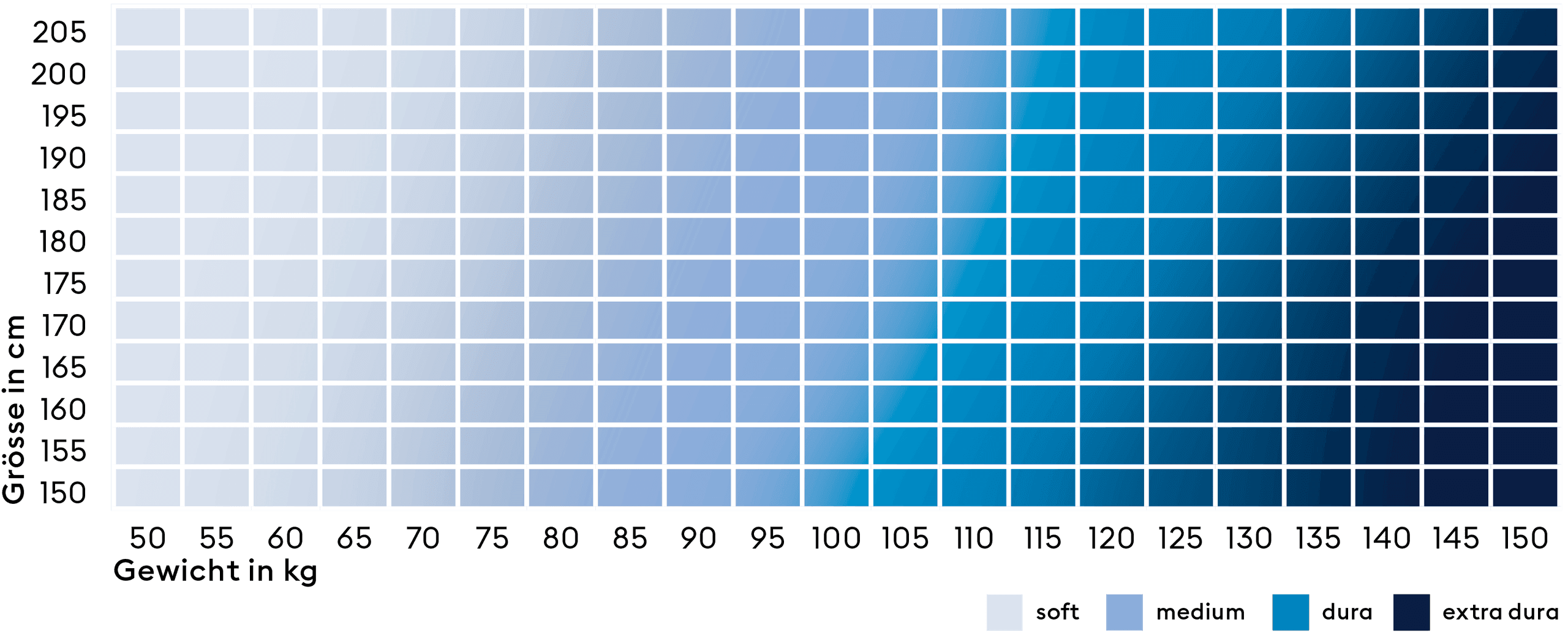
"A firm mattress is good for the back" – this assumption is now considered outdated. If the body, especially around the shoulders and hips, can't sink far enough into the surface, this can lead to tension and impaired circulation. Lighter people are therefore generally recommended a softer mattress, while heavier people need more support and usually do better on firmer mattresses. Manufacturers' firmness ratings serve as a guideline – but actual comfort can vary from case to case. So it's best to try it out yourself. Do you share your bed with someone much heavier or lighter than you? Then mattresses with different firmness levels but the same height are recommended. An unwanted "gap in the middle" can easily be avoided by using a single mattress cover.
The ratio of height to weight provides guidance on the right firmness level.
Sleeping position
Do you tend to sleep on your back, on your side, or on your stomach? In every sleeping position, body weight should be distributed as evenly as possible to avoid pressure points. When lying on your back, relieving the neck and supporting the lumbar spine are key, while in the side position the shoulders and pelvis should be able to sink nicely into the surface. If you sleep on your stomach, make sure the middle of your body never "sags". The spine should always rest in a natural and comfortable position. If you're lying awkwardly, your body may respond with unnecessary turning, waking up, or even pain – at the expense of your sleep quality and quality of life.
An optimal mattress lets the spine rest in a straight line.
Sleep climate
A pleasantly warm and dry bed helps you feel comfortable and relax as you fall asleep. Ideal climatic conditions exist when your body temperature stays at a constant level. Since everyone sweats at night, the mattress and bedding should absorb and regulate moisture. Natural materials, such as sheep's wool in the sleep surface, promote a good sleep climate. Wool has good heat-retention properties and can absorb and transport away moisture without feeling wet. This prevents both sweating and feeling cold, while also being antibacterial and self-cleaning. For people who sweat heavily, good ventilation is important. Choose a mattress with high breathability, such as a model with a spring core. People who tend to feel cold, on the other hand, are recommended a comfort foam mattress because of its high thermal insulation (learn more about the different mattress types below).
Hygiene
Good bed hygiene is an important factor for good health. Allergy sufferers in particular should pay attention to whether the cover is washable when buying. Covers are often also treated against bacteria, fungi and mites – in extreme cases, an encasing, i.e. a mite-allergen-proof inner cover, can provide relief. In any case, you should air out your bed daily, change your bedding and pyjamas regularly, and turn your mattress. We recommend buying a new one every ten years, since after that long a mattress lacks not only hygiene but also supportive strength.
Take your time trying it out
It's advisable to shop for a mattress in the morning – after all, what mattress doesn't feel comfortable after a long day at work? Bring your partner along if needed, since they may have fundamentally different needs, and take your time choosing. Feel free to bring your own pillow too, as it affects your lying position around the neck. If in doubt, or before making your final purchase decision, it's a good idea to spend 10-15 minutes on a mattress. Close your eyes and feel. It takes a few minutes for the material to fully adapt to your body shape through pressure and warmth. Do you feel comfortable and relaxed, with no pain and no limbs falling asleep? Then you've probably found the basis for deep, healthy sleep.
Feel free to stop by and see us in Bischofszell and take your time trying out different mattresses – we wish you lots of enjoyment in choosing your new mattress.
Source: This article is based on an article from the BICO sleep blog (bico.ch). The general purchasing recommendations it contains are not tied to any particular brand or manufacturer research.


