Sleep tips
How to find the right firmness level for your mattress
By Deluxe Sleep · Published on
Contents
- How to find the right firmness level for your mattress
- Why a good sleep system matters so much
- Mattress firmness level – what does it mean?
- H3 or H4? How differences between firmness levels arise
- Not every mattress offers the same number of firmness levels
- Mattress too firm or too soft? How to recognise the right firmness level
- Personal factors for the optimal mattress firmness level
- Supporting measures for more lying comfort
- Conclusion
How to find the right firmness level for your mattress
We all hope to sleep well and wake up refreshed. Unfortunately, that is not the reality for everyone: do you, too, sometimes wake up with tension or back pain? Physical discomfort and a lack of restful sleep can, among other things, be the result of an unsuitable mattress firmness level. That's why we take a look at the key questions surrounding firmness levels: what are firmness levels, how do the different levels differ, and what does the optimal firmness level depend on?
Why a good sleep system matters so much
A sleep system is the combination of bed frame, slatted base, mattress and pillow. Ideally, all the components of the sleep system are matched to one another: then pressure is distributed evenly across the entire sleeping surface, and the body's zones are relieved or supported exactly where needed. A good sleep system has a positive effect on your body and your sleep and causes neither back pain nor circulation problems. You can tell that your sleep system is good and that you are lying correctly on your mattress by the fact that your spine does not sag, but forms a straight line. Likewise, a good sleep system does not create uncomfortable pressure points on the body, the kind that can make your arm fall asleep, for example.
Mattress firmness level – what does it mean?
The firmness level is a measure of how firm a mattress is: it tells you how hard or soft a mattress is. Most mattresses are available in three to five different firmness levels (H1-H3, or H1-H5), with firmness level 1 being the softest. Incidentally, firmness ratings are not standardised. Accordingly, firmness levels can vary considerably from manufacturer to manufacturer, and even from model to model.
H3 or H4? How differences between firmness levels arise
When is a mattress perceived as firm or soft? Or, put differently: how do the differences between the individual firmness levels arise? Whether a mattress has firmness level 1 or 5 is defined by the following components:
- The mattress type: a mattress's firmness level depends on various factors, including the type of mattress. For example, mattresses can be made of viscoelastic foam, cold foam or latex, or have a spring core.
- The compression hardness, i.e. the firmness of the material: the more force it takes to press the mattress in, the higher its firmness level.
- The mattress's resilience and dimensional stability: this refers to the mattress's ability not to let the body sink in without resistance, but to support it properly and return to its original shape after the load is removed.
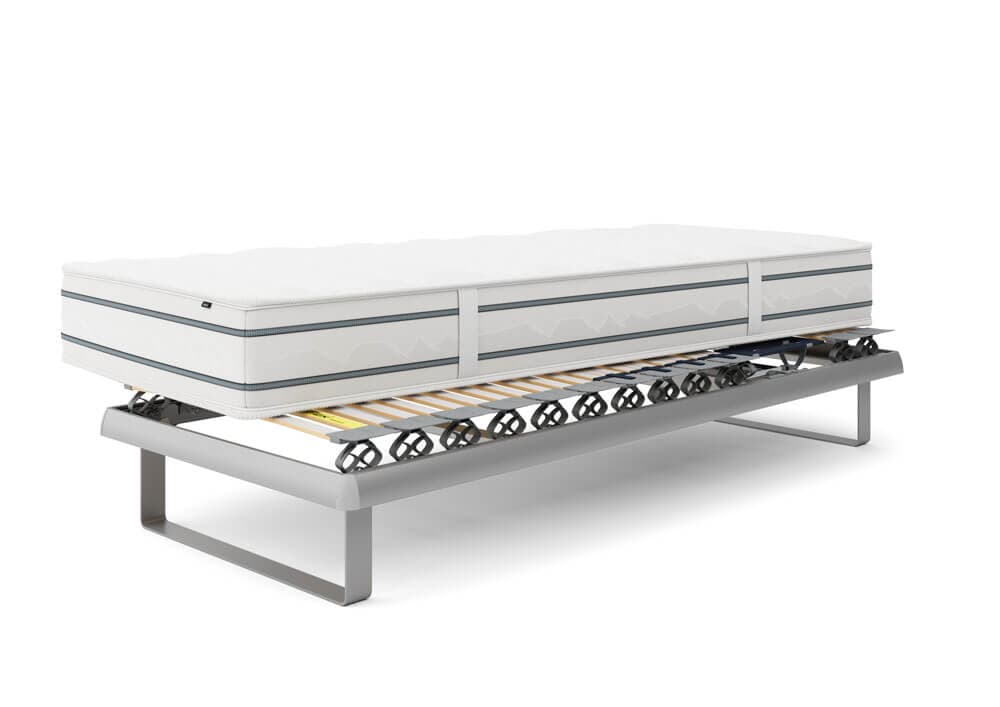
- The interplay between mattress and insert frame: an insert frame is the mattress's foundation and can influence the firmness of the sleeping surface. It offers the option of adjusting the mattress individually and taking different needs into account – for example during pregnancy, or in cases of pain, injury or weight gain.
Not every mattress offers the same number of firmness grades
Some of our range lets you choose the firmness, some does not. Most of those models offer three grades, some two, a few four – and the TEMPUR Matratze Pro CoolQuilt offers five. Other models come deliberately in a single version, such as the BICO Matratze Isabelle Star in “medium”.
On top of that, the labels are not standardised. BICO calls its grades “soft”, “medium”, “dura” and “extra dura”, roviva uses “soft”, “medium” and “firm”, Softsleep “soft”, “medium” and “fest”. A “medium” is therefore not the same from one manufacturer to the next – when in doubt, compare how it feels rather than what the label says.
Not every mattress offers the same number of firmness levels
Some of our range lets you choose the firmness level freely, some does not. Most of these models offer three levels, some two, a few four – the TEMPUR Matratze Pro CoolQuilt even offers five. Other models are deliberately available in only one version, such as the BICO Isabelle Star mattress in "medium".
On top of that, the labels are not standardised. BICO calls its levels "soft", "medium", "dura" and "extra dura"; roviva uses "soft", "medium" and "firm"; Softsleep uses "soft", "medium" and "fest". So a "medium" is not the same for every manufacturer – if in doubt, don't compare the labels, compare the lying feel.
Mattress too firm or too soft? How to recognise the right firmness level
An optimal firmness level and suitable zoning are important for an orthopedically healthy spinal position and for good support and relief of the body. To ensure support and relief in the right places, the mattress should have zoning that adapts to the needs of the different body regions – that is, head, shoulders, lordosis or lower lumbar spine, hips and legs. You can tell a mattress has too low a firmness level – that is, is too soft – if it does not provide enough support and, for example, lets your hips sag. As a result, your spine is not in an optimal position. If, on the other hand, the mattress's firmness level is too high, your hips may not be able to sink in properly when lying on your side, and your shoulder may buckle. Both mattresses that are too firm and mattresses that are too soft can lead to back pain and tension. If you lie on a mattress that is too firm, your body can sense the uncomfortable position and seek an alternative lying position for relief. The frequent turning that comes with this can disturb your sleep or even wake you up. And if blood flow is unfavourably impeded due to incorrect pressure, circulation problems can even result.
Personal factors for the optimal mattress firmness level
Firmness is an individual matter: it is defined by the following factors, which vary from person to person:
- The ratio of body weight to body height: people who are relatively lighter tend to be advised to choose a softer mattress; people who are relatively heavier, a somewhat firmer one
- Body build: characteristics of the shoulders, waist and hips (e.g. broad shoulders, narrow waist and hips) affect how the body's weight is distributed
- Sleeping position: are you a back sleeper, side sleeper or stomach sleeper?
- Personal preference for lying firmness
For restful sleep, we strongly recommend paying attention to your individual needs and preferences when choosing a mattress. Get expert advice on this and try out different mattress firmness levels. When trying a mattress, make sure that your shoulders and hips can sink in and that your spine forms a straight line. For back and side sleepers, the lumbar spine should also rest on the mattress in such a way that no gap forms between the sleeping surface and the body. In general, you should be able to lie on the mattress relaxed and free of pressure points on the body. Otherwise, the firmness level of your mattress is not ideal.
Supporting measures for more lying comfort
If you would like to enjoy even more lying comfort while sleeping, a topper can be a worthwhile addition to your ideal mattress. It not only provides a softer lying feel, but also protects your mattress at the same time. If a couple needs two different firmness levels and therefore two mattresses, the unwanted "visitor's gap" can be avoided with a shared mattress cover or a bridging pad.
Conclusion
Firmness levels are an individual matter. So choose a firmness level that suits your personal needs and preferences. To find the firmness level that is right for you, trying the mattress in person is recommended: this lets you feel the actual lying sensation of the mattress and notice whether the firmness level is in harmony with your individual factors.
Source: this article is based on a piece from the BICO sleep blog (bico.ch). The research findings, product developments and test results mentioned in it come from BICO or from the respective named third parties.